
Economy
Melvor Idle 2 Money Making Guide: Compare Net GP per Hour
Compare Fishing, Thieving and Smithing for Melvor Idle 2 money making, including net GP per hour and preparation costs.
Fund your first purchases with quest rewards and surplus gathering. After 15 Hobgolbin kills, try Hobgolbin Camp for 100 GP plus a chest per clear. Decide whether to sell that chest or open it for the Hobforge Gloves needed by Rocky Rumble.
Money making methods by stage
| Method | When to try | Main benefit | Hidden cost |
|---|---|---|---|
| Fishing | After initial unlock | Food plus saleable surplus | Fish retained for Cooking |
| Woodcutting or Mining | Early | Simple resource sales | Materials needed for upgrades |
| Thieving | After unlocking it and building food reserves | Loot and direct coin rewards | Failed attempts, healing and tools |
| Mining and Smithing | Once recipes and tools support it | Saleable manufactured equipment | Mining, smelting and crafting time |
| Hobgolbin Camp | After 15 Hobgolbin kills | 100 GP plus a chest worth 400 GP unopened | Food, ammunition or runes and the chance to obtain Hobforge Gloves |
| Deep Blue Fishing | Fishing 98, Open Ocean | Raw Manta Ray and Raw Whale | Training investment and optional bait |
These are candidate methods, not a verified universal ranking. The November 25 patch fixed bait preservation and introduced a new Thieving distraction, so older calculations may no longer match your character.
Early game: sell the surplus, not your progression
Fish at a location that supplies both useful food and saleable output. Keep a reserve for Cooking before selling the remainder. Apply the same principle to ore and logs. If selling the last stack prevents your next tool upgrade, the apparent profit is misleading.
Raw Shrimp sell for 5 GP each in the launch-build data, while Raw Herring sell for 15 GP. One hundred surplus Herring therefore return 1,500 GP before costs, versus 500 GP for the same number of Shrimp. That comparison illustrates the sale value of a stack, not the hourly rate. Check which stack you can fill faster and keep the fish needed for Cooking.
When Hobgolbin Camp beats gathering
In the launch build, selling the unopened chest converts each clear to 500 GP gross. For example, 12 clears in an observed hour would yield 6,000 GP before food and ammunition. A player going after Hobforge Gloves should omit unopened chest sales from that session’s cash estimate. Open the chests instead and record the actual sale value of loot you do not need. Compare both approaches in the Money Making Calculator.
Thieving: choose a sustainable target
Citizen, Thug and Craftsman are early candidates worth comparing as their levels become available. Their loot differs, and a higher-level target is not automatically more profitable. Inspect the success chance, failure damage and available food before running a test. A target with moderate loot and frequent success may outperform a richer target that repeatedly stuns your character.
Locked chests can become attractive once you have their matching reusable keys. If you rely on consumable lockpicks instead, subtract their replacement cost and preparation time. Retain rare equipment that improves future Thieving rather than immediately converting it to GP. See the Thieving guide for target selection.
Smithing: calculate the full chain
Compare finished equipment with the alternative of selling its raw materials. If you gather and smelt everything yourself, include that work in the time denominator. A recipe showing a large sale value per crafting action is not proof of a strong end-to-end GP rate.
For each candidate recipe, record the required bars, ore and any extra components. Determine how long it takes your character to obtain those inputs. Include failed production, where applicable, and use actual quantities after bonuses. Then compare the total value with selling the inputs directly.
Compare the value added by a stocked recipe
| Recipe | Required skill level | Materials to sell instead | Output sale | Base time | Incremental GP per crafting hour |
|---|---|---|---|---|---|
| Copper Bar | Smithing 5 | 1 Copper Ore at 3 GP | 7 GP | 2.5 s | 5,760 |
| Iron Bar | Smithing 10 | 1 Iron Ore at 6 GP | 12 GP | 2.5 s | 8,640 |
| Gold Bar | Smithing 38 | 1 Gold Ore at 16 GP | 42 GP | 2.5 s | 37,440 |
| Gold Topaz Amulet | Crafting 38 | 2 Gold Bars at 42 GP and 1 Topaz at 29 GP | 210 GP | 6 s | 58,200 |
| Gold Diamond Amulet | Crafting 92 | 2 Gold Bars at 42 GP and 1 Diamond at 355 GP | 820 GP | 14 s | about 97,971 |
| Gold Jadestone Amulet | Crafting 98 | 2 Gold Bars at 42 GP and 1 Jadestone at 334 GP | 1,028 GP | 16 s | 137,250 |
These are launch-build conversion margins for materials already in your bank. The worksheet subtracts input sale values and uses the full base crafting interval. It ignores time to obtain materials, output doubling, mastery, preservation and selling time. Compare up to eight stocked recipes by level in the Money Making Calculator. Keep some Gold Bars for upgrade costs and compare the original sale value if you must cut the gemstones first.
Late-game Fishing: Deep Blue
Deep Blue unlocks at Fishing 98 in Open Ocean. In the launch build, Raw Manta Ray sold for 830 GP and Raw Whale for 4,500 GP. A batch of 90 Manta Ray and 10 Whale would sell for 119,700 GP before bait. This is a sale example, independent of how long that batch takes or what catch mix you actually get. Measure the elapsed time and put preparation and bait costs into the calculator.
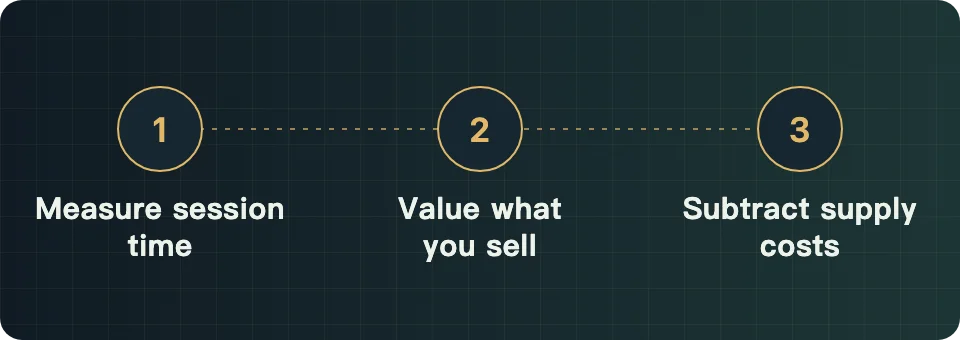
Original editorial diagram based on the planning steps in this guide.
How to calculate your actual GP per hour
For a completed session, use:
Net GP/h = (coin rewards + sale value of outputs - consumed input value) / elapsed hours
For a self-supplied production chain, include the time spent gathering and processing materials, but do not also subtract the sale value of the same self-gathered inputs when calculating cash profit. For an opportunity-cost comparison, subtract their sale value and explicitly label the result as incremental processing profit instead.
For example, imagine a recipe batch sells for 12,000 GP and requires 3,000 GP of purchased supplies. If the full session takes 30 minutes, net income is 18,000 GP/h. This is hypothetical arithmetic, not a game recipe or price claim.
Where to spend your GP
Prioritize purchases that increase production for your next long session, remove a recurring storage bottleneck, or make dangerous training sustainable. A purchase that costs 20,000 GP and genuinely increases net income by 5,000 GP/h would repay its cost in four hours of that activity. Use your actual rates rather than assuming an advertised bonus produces an identical income gain.
Frequently asked questions
Is Thieving the best early money maker?
Not for every character. Food costs and failures can make safe gathering a better starting point.
Is Deep Blue the best money maker in the game?
That is not established. It is a high-level candidate supported by launch-period community calculations, but a full comparison requires current modifiers and recipe data.
Should I sell cooked food?
Only sell what you do not need for survival or quests. Compare the sale premium with the extra Cooking time. For food supply and leveling, see the Fishing guide.
Sources & References
- Current patch
- Launch notes
- Community Deep Blue estimate and competing Smithing analysis
- Thieving data, launch build
- Fishing data, launch build
- Community money-making model (assumptions vary)
- Launch-build item values
- Hobgolbin Chest source, reward and sell value
- Steam early access build 26724394 reference: GoldBar
- Steam early access build 26724394 reference: crafting
Related video

Melvor Idle 2: Beginner’s Guide — Everything You Need to Know
Recorded in the v0.11.4-alpha demo. The current Early Access interface may differ.