
Skill training
Melvor Idle 2 Skills to Level First
Find the best early skills to train in Melvor Idle 2, with unlock milestones, food, gear, and long-term efficiency priorities.
Start with the skills that supply your next unlock. Fishing and Cooking build a food reserve, while Mining and Smithing support equipment. Take an Astrology or Agility detour when its reward helps an activity you will repeat.
Early skills by what they unlock
| Skill or pair | First goal |
|---|---|
| Woodcutting | Reach level 2 for Fishing and Mining. Reach level 5 for Crafting and level 8 if you want an early Astrology unlock. |
| Fishing and Cooking | Fish 20 Raw Shrimp at Shallow Pools to open Cooking. Cooking 10 opens Thieving and 15 opens Agility. |
| Mining and Smithing | Reach Mining 2 for Smithing, then make the Stone Sword required for Combat. |
| Crafting | Produce the component needed for your next upgrade. |
| Astrology and Agility | Astrology also has a Farming 5 unlock route. For Agility, the Cooking 15 route also improves your food supply. |
| Thieving | Try an unlocked target while you can observe failures and healing. |
This is a suggested order based on dependencies. Use the current quest or unlock panel to decide which goal comes first.
Why food comes before Thieving
Thieving can be attractive because you can obtain loot without mining or manufacturing every item. However, failed attempts can damage your character. An unlocked target is not necessarily a sustainable target. Train Cooking to build both a stock of healing items and access to other skills. Once you have enough health and a reliable food supply, experiment with Thieving in short sessions.
For a new character, Fishing has two advantages: you can build a valuable material reserve and avoid paying the health cost of unsuccessful thefts. Its value is not limited to the sale price of raw fish. Every meal produced now can reduce time spent restocking later.
Why Mining and Smithing should stay close together
A high Mining level is useful only if you can turn the materials into what you need. Match the two skills to an upcoming equipment recipe. If Smithing is behind, mine enough resources to close that gap before pursuing a new ore tier. If you already have bars in storage, do not spend another session mining automatically.
Equipment for combat and upgrades for gathering compete for some materials. Reserve the resources needed for your next tool purchase or quest. Treat selling bars as a deliberate decision, not a default response to a full bank.
When Astrology and Agility become worth the detour
Both skills were introduced in the Early Access launch. Their value comes in part from improving other activities, so the right investment depends on how much training remains. Look for bonuses that apply to the activity you plan to repeat for hours, not an impressive-looking bonus for a skill you rarely use.
One way to estimate a detour is to compare its training time with the time it saves. Suppose an upgrade takes one hour to earn and reduces an action's actual duration by 10%. Under unchanged conditions, ten hours of that action at the old speed would save one hour. This is an illustrative calculation, not an in-game bonus claim. If you will train the action for much longer, the investment may be worthwhile; if you only need a handful of items, it may not be.
Do not count the same bonus twice. Output doubling may improve material production without increasing experience by the same proportion. A shorter interval may improve both. Read the actual modifier text before estimating its benefit.
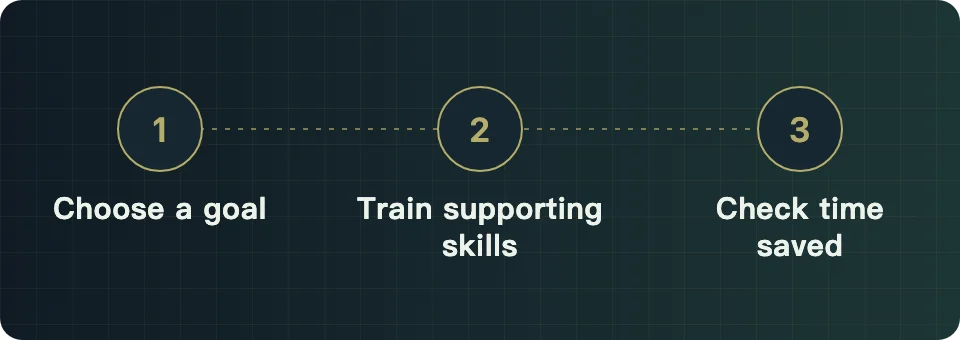
Original editorial diagram based on the planning steps in this guide.
Pick a route based on your goal
If you want to reach combat quickly
Prioritize Mining and Smithing immediately after unlocking food production. Make a usable weapon, build a food reserve, and fight manageable opponents. Return to non-combat training when a new equipment requirement or food shortage blocks you. Avoid spending all your early GP on damage improvements if survivability is the constraint.
If you want reliable idle income
Use Fishing or another gathering action you can sustain without supervision. Sell only surplus resources. Compare alternative activities by net GP per hour, including preparation time. The money making guide explains that comparison.
If you want broad quest progress
Use the next quest requirements as your skill targets. Move between skills in short blocks until you can satisfy them. It is more useful to unlock several connected recipes than to accumulate experience far above a requirement while other skills remain locked.
Train for the next hard-to-replace quest supply
Plan Act 2 preparation before The Big City if you are maintaining a ranged character. The quest requires 100 Sea Griffin Arrows and a True-Shot Potion, so Ranged levels alone do not remove the bottleneck. The launch journal lists Fletching, Herblore and Hunting at 45 for those steps. Before leaving Act 1, group work on food and fishing with Apprentice guild milestones to earn the rank benefit while gathering useful supplies.
Common efficiency traps
A long grind can be wasteful when a nearby tool upgrade would shorten it. Conversely, buying every tool immediately can drain the money required to open a more useful activity. Check both the purchase cost and your planned usage. Also check whether a Mastery Guild task overlaps with the materials you already need.
Avoid assuming that a high-level target offers the best effective XP. Fishing intervals vary, and dangerous activities can lose time through failures and resource depletion. Compare the output you actually need per unit of time.
Use the XP time estimator with experience gained per hour from your own session.
Frequently asked questions
Should I train every skill evenly?
No. Keep dependent skills close enough to support your next goal, but prioritize milestones that unlock useful actions.
Should I max Fishing before anything else?
Not for a balanced start. A long Fishing session can help income and food production, but Cooking and equipment upgrades let you benefit from those catches sooner.
What is the fastest route to level 99?
There is no verified universal route here. Character modifiers, quest access, and the resources used for training change the comparison. See the progression guide for a staged approach.
Sources & References
Related video
Melvor Idle 2: Beginner’s Guide — Everything You Need to Know
Recorded in the v0.11.4-alpha demo. The current Early Access interface may differ.